Open Studio
Open Studio: 3 is the Magic Number
Activity
In this workshop, Jenifer K Wofford shares examples of the magic that comes in sets of three from her own work as well as others. We explore a variety of three-panel visual art formats and make variations of our own, from improvisational collaborations to more structured, individual pieces.
The rule of three principle asserts things that come in three are more powerful, humorous, satisfying, and effective. The human mind loves to construct meaning out of rhythm and structure, and the number three has a beat that has forever appealed to creative minds.
For example, a classic three-panel comic has an almost haiku-like perfection in its brevity and economy of storytelling. Similarly, a classic fine-art triptych also sets up complex associations and narratives through images within its three panels.
Easily adapt this Open Studio and lesson plan to a wide variety of contexts, materials, and age groups.
Media
Various 2D media — you can use whatever is handy for drawing, painting, collage, print
Materials
- Standard 8.5 x 11 paper
- Scissors
- Pencils
- Colored pencils or pens
- Black markers
- Glue sticks
Download This Activity
About Open Studio
Designed by practicing artists, the Open Studio classroom activities aim to connect high school teachers and students with key ideas and issues in contemporary art. See all of the Open Studio activities.
Warm-up #1: Le Cadavre Exquis (Exquisite Corpse)
This requires three people. Each person will draw one-third of a body: top, middle, bottom. The stranger the better. It doesn’t even have to be human.
1. First person:
Top one-third: Fold a sheet of paper into thirds, as in the shape of an envelope. On the top third, draw a head and shoulders. (It doesn’t have to be human.) When you’re done, extend the shoulders a tiny bit across the edge where the paper folds to create connecting marks. Flip your drawing over, keeping the paper folded up. Hand it to the next person with the blank, middle side up so they can continue the drawing.
2. Next person:
Middle one-third: Start at the connecting marks and draw the middle of a body. (You can include arms, wings, tentacles, etc.) When you’re done, create two more connecting marks that extend into the bottom third. Flip your drawing over, keeping the paper folded up. Hand it to the next person with the blank, bottom side up so they can continue the drawing.
3. Third person:
Bottom one-third: Start at the connecting marks and draw the lower one-third of the body. (You can include legs, tentacles, claws, etc.) When you’re done, unfold the drawing and see what you and your collaborators have created.
Warm-up #2: Three-Part Comic
First, fold and cut a piece of paper, map-style, following this graphic (courtesy Keri Smith) to make a little booklet that has a front cover, back cover, and three spreads.
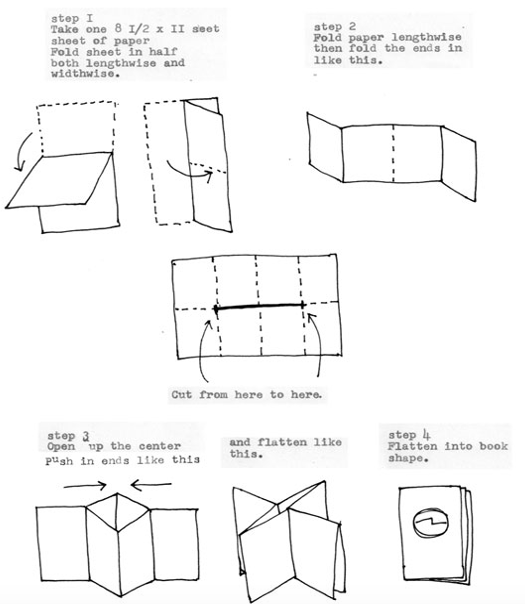
From here, draw back to front on the spreads:
On the third spread, draw a close-up of a character. Put them into a scene or place. Have their face or body show an emotion (happy, sad, scared, etc.).
On the second spread, draw a big speech bubble. Around the speech bubble, draw lots of lines that convey a particular energy or mood — bad, good, happy, sad, etc. Write one to three words inside the speech bubble. Add punctuation that adds drama.
On the first spread, draw a place. Add the same character from the third spread but much older or younger.
Now put a title on the front cover. What kind of story emerged from this?
Final Assignment: Three-Panel Action
On three separate sheets of paper, create a three-panel storyboard, comic, or triptych that shows the completion of a motion or action. Spend about 20 minutes on each panel.
This action can be big (the fall of the Roman Empire) or small (the fall of a coffee cup) or abstract and illogical. A narrative will emerge whether you intend it or not.
While you’re making each panel, consider:
The three panels should be different from one another but still feel thematically unified and visually connected to each other.
How can you do this through consistent color, subject matter, character, composition, or style?
How can you create a sense of space and time?
After 60 minutes, we’ll install these works on the wall for discussion and critique. What stories and narratives emerged?
Jenifer K Wofford

Megan Badilla