Talk
Suzanne Jackson and Friends
Related Exhibition Suzanne Jackson: What Is Love
Friday, Sep 26, 2025
6 p.m.
Floor 1, Phyllis Wattis Theater*
Free with RSVP
*For this after-hours program, please enter the museum via the entrance at Minna Street.
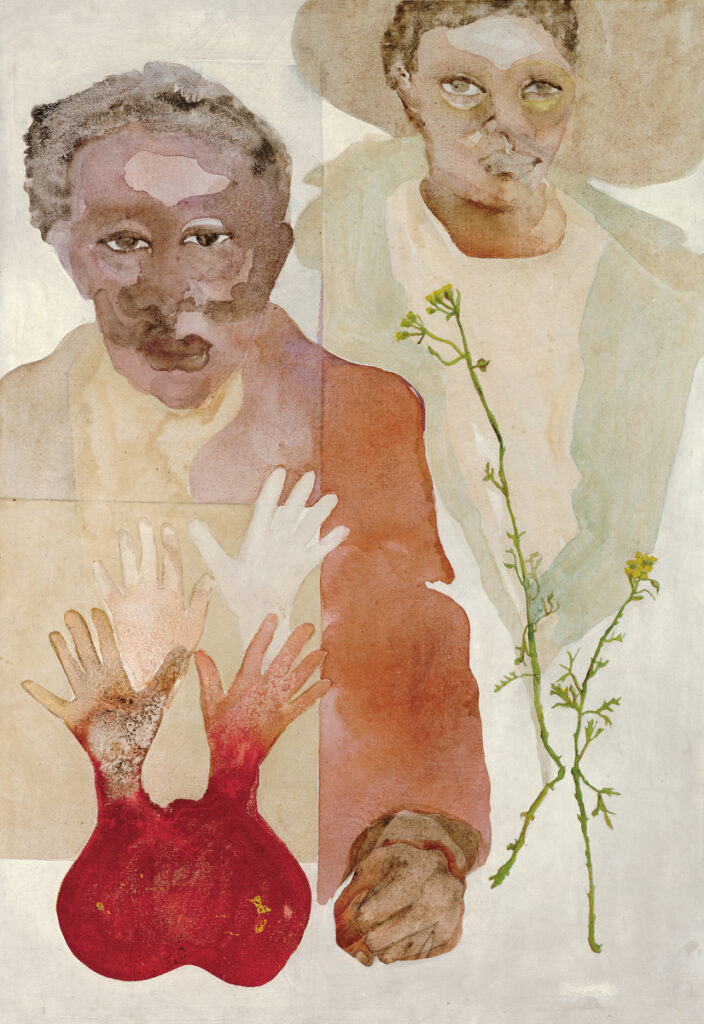
Throughout her creative life, Suzanne Jackson has uncovered creative outlets across a span of disciplines. From dance to theater, painting to curating, and much more, Jackson’s career is a fusion of inspiration and reflections that pull from her rich engagement across the arts, people, and communities. Today, hear from friends, fellow artists, and people influenced by Jackson. Through short presentations, each speaker will touch on a different aspect of Jackson’s work and life, along with their personal connection to her. Speakers include Greg Edwards, Mildred Howard, Alison Saar, and Ian White.
About the Artist
Suzanne Jackson lives and works in Savannah, Georgia, and St. Remy, New York. For nearly five decades, the artist has worked experimentally across mediums, including drawing, painting, poetry, dance, theater, and costume design. In the early 1970s, Jackson worked as an artist and teacher in Los Angeles, where she engaged a community of artist peers and established Gallery 32, showcasing figures like David Hammons, Senga Nengudi, and Betye Saar. During this time, Jackson was known for her figurative paintings using layers of acrylic wash to depict the melding of humans and nature. Jackson’s recent “environmental abstractions” are composed of pure acrylic and recycled materials from the artist’s life such as produce bags, rods, paper fragments, peanut shells, bamboo bells, and leather string. In 2023, the artist established the Suzanne Fitzallen Jackson Foundation, dedicated to providing fully supported residencies for emerging and mid-career artists, particularly those underrepresented from the South. The foundation is based in her beloved Savannah home.
About the Speakers
Nathaniel G. Nesmith, a 20th- and 21st-century drama specialist, earned a BA and MA in criminal justice from John Jay College of Criminal Justice, a BFA in theatre from Temple University, and an MFA in playwriting and a PhD in theatre from Columbia University. His John Jay master’s thesis explored criminality in the works of four Pulitzer Prize–winning African American playwrights (Charles Gordone, Charles Fuller, August Wilson, and Suzan-Lori Parks). His Columbia dissertation, Freedom and Equality Now! Contextualizing the Nexus between the Civil Rights Movement and Drama, examines how central issues of the American Civil Rights Movement were dramatized on stage. He has taught at Columbia University, the University of Pennsylvania, Baruch College, City College of New York, John Jay College of Criminal Justice, Marymount Manhattan College, Middlebury College, Skidmore College, and Union College. He is a member of Ensemble Studio Theatre Playwrights Unit. An independent scholar, he has published articles in African American Review, American Theatre, Black Masks, New England Review, The Black Scholar, The Drama Review, The Dramatist, The Journal of American Drama and Theatre, The New York Times, The Philadelphia Inquirer, The Yale Review, and other publications.
Gregory Wiley Edwards began his career as a photographer in the 1960s, documenting significant social, political, and artistic events in Los Angeles. He was a member of the revolutionary street theatre group Bodacious Buggerilla and a notable participant in the 1971 Watts Festival Art Show. During the 1970s, Edwards organized the group exhibition Double Diamond at the Contemporary Arts Museum in Houston and was involved with the Studio Z Crew during the Alternative Artspace scene. He also organized important symposiums on public art and the role of business in the art world, and he invited renowned Nigerian woodcarver Lamidi Fakeye on significant tours in Southern California. In the 1980s, Edwards exhibited with his brother, sculptor Melvin Edwards, in New York and focused on solo shows to emphasize his commitment to abstract painting. The 1990s saw Edwards and his family relocate to the San Francisco Bay Area, where his travels to various international cities influenced his artistic perspective. He continues to draw, paint, and experiment with printmaking at his studio in Sonoma County.
Mildred Howard is a media and installation artist whose work draws on a wide range of historical and contemporary experiences. Creating “an architecture for the remainder,” she questions perceptions and addresses misconceptions on how the world is viewed. She often uses found objects or the readymade. She has had nearly 45 years of historically important exhibitions. Her public art can be seen throughout the Bay Area, including her recent 18-foot bronze triptych Promissory Note (2022) at Third Street and Evans Avenue in San Francisco. Howard has been the recipient of numerous awards, including the Adaline Kent Award from the San Francisco Art Institute, the Joan Mitchell Fellowship, the Anonymous Was a Woman Award, a National Endowment for the Arts Grant in Sculpture, a Lee Krasner Lifetime Achievement Award, and the 2025 Guggenheim Fellowship. She has exhibited throughout the United States and in Berlin, Cairo, and Paris. She is represented by galleries in San Francisco, Los Angeles, Santa Fe, and New York.
Alison Saar’s sculpture, prints, and paintings address issues of race, gender, and spirit. She studied art and art history at Scripps College and received an MFA from the Otis Art Institute. Her awards include a John Simon Guggenheim Memorial Foundation Fellowship, National Endowment Fellowships, and the United States Artists Fellowship. Alison has exhibited at many museums, including the Hirshhorn Museum and Sculpture Garden and the Whitney Museum of American Art. Her art is represented in the collections of the Hirshhorn Museum and Sculpture Garden, the Metropolitan Museum of Art and the Whitney Museum of American Art. She currently resides in Los Angeles and is represented by L.A. Louver Gallery.
Ian White is a visual artist, curator, educator, and chief executive of the Charles White Archives based in Los Angeles. Influenced by his father, Charles White, a significant figure in 20th-century art and the community of artists, musicians, actors, and activists in which he was raised, White’s artistic practice includes narrative murals, abstract sculpture, and installations. White wrote and illustrated Grandpa and the Library: How Charles White Learned to Paint, for The Museum of Modern Art, New York, and curated an exhibition at the Los Angeles County Museum of Art, Life Model: Charles White and His Students. He was an assistant curator for Monumental Practice: Charles White at David Zwirner Gallery, New York, and Charles White — Leonardo da Vinci at The Museum of Modern Art, New York. He is developing a civic art intervention with the Los Angeles County Department of Arts and Culture at Charles White Park in Altadena, CA.
Accessibility Information
American Sign Language (ASL) interpretation and assisted listening devices are available upon request 10 business days in advance.
Please email publicengagement@sfmoma.org, and we will do our best to fulfill your request.